%20(dark%20background).png)
Stroke: An Occupational Therapist's Experience
- William Croninger

- Apr 21
- 10 min read
Updated: May 10
This article will explore both my professional and personal perspectives, beginning with the latter...

Having a stroke, from my perspective...
It was a normal day on 8th January 2026 - up around 4am, breakfast, then to the YMCA to practice my martial arts. Later that morning, walking down the hall in our house, I noticed my gait had changed and I was beginning to step more heavily onto my left heel.
In the 39 years I have worked as an Occupational Therapist, I had occasionally wondered what the onset of a stroke might feel like. As I reached the bedroom, to my horror, I began to suspect I was learning this in real time, as my left hand was also demonstrating a loss of coordination.
My wife and I drove to the emergency department (ED), at the US hospital where I had worked for the past twelve years. However, the medical worker there didn't seem to be quite comfortable with performing a neurological exam, diagnosing me with 'dizziness'. We left four hours later, without being seen by a physician.
The next day, I found I was exhausted soon after starting my sword training, which convinced me I needed to visit another ED. The resident on duty quickly sent me for CAT scans and then ran me through a well-organised set of neurological assessments. Nothing appeared in the scans, but he strongly encouraged me to travel to a nearby hospital that offered MRI testing, as cerebrovascular accidents (CVAs) sometimes take some time to become visible.

My sister (a retired nurse) was even more directive, with her "GET in the car!" - and we soon headed for a Veterans Administration hospital, thirty miles South. I won't bore you with all the details, but the professionals who make up this service were exemplary in their compassion, expertise - and ability to clearly explain findings to me and my support group (of spouse, daughter, sister and former co-workers). They were very much the 'third leg' of keeping my spirits up and giving me gentle nudges in those first few overwhelming hours. All these people made it possible for me to return home - and begin this article six days later, with the understanding that I had incurred two small CVAs on that first day.
While in the VA Medical Center, one of the first deficits I noted was not being able to use a fork in my left hand while eating. It seemed like meals took twice as long as they should, as I chased food around, and often off my plate... That night, part of what I did while in bed was to analyse the components of my left arm dysmetria. Dysmetria is a difficulty controlling the distance, speed and range of motion required for coordinated movements.

In your occupational therapy classes, you will, at some point, have covered activity analysis. I well remember how much I disliked this class, as (for us) it involved analysing the motor, sensory, cognitive and psychological components of macramé! Yet, were I to be completely honest, it has been one of the most useful life skills I have ever learnt - used in my occupational therapy treatments, leadership duties in the military and woodworking, to name but a few.

I spent the initial days analysing my own activities of daily living (ADLs) and looking for how to use objects in my hospital room to address my dysmetria. Initially, I would reach to touch various body parts. As my ability to touch these improved, I moved to touching parts of my bed, followed by touching objects with a specific finger on the left hand. I was still able to completely extend the arm from supine or sitting positions, but it displayed a definite case of the 'wobbles'. As the ability to accurately point at a distant object improved, I began to concentrate on diminishing the wobbles.
The day I could sit on the edge of the bed and not push food off the plate was definitely a thrill... One of the next challenges was being able to tie a hospital gown behind my neck. It was not a boring stay, to be sure!
Thoughts for the acute care therapist
All too often, a client will say "Well, I'm off to therapy now", meaning physiotherapy (physical therapy), following time with his or her Occupational Therapist. You may be left with the reaction of "What am I, chopped liver?" It is disappointing and will probably always exist as an artifact of our use of daily activities as our therapeutic tool. Not at all as impressive as the equipment found in the gym... Your client will likely want to focus on regaining mobility; that is of vital importance of course. But I recall the response of an Occupational Therapist, who replied something like:
"I understand that mobility is vital to your future independence, but you will need to be able to use your hands when you arrive at your destination!"
The Occupational Therapist as a teacher
In a previous article, Are You Treating the 'Whole' Patient? (2024, on the Hub), I expressed my belief that one of the most important skills we have as Occupational Therapists is our ability to 'get to know' our patients. I cannot emphasise this more strongly or deeply. Take the time to learn your client's history; vocations, avocations (hobbies), interests, etc.

In terms that your client/their family can understand, educate them on the physical and neurological components of what has happened to them. Stress to them how occupational therapy will positively impact their ability to return to independence. I cannot begin to recall the number of times a stroke survivor would tell me "I want to work on increasing the strength in my hand/arm." Physicians would remark on how strong my own arm was, even after the CVA. The issue was not with strength, but in my inability to control the limb.
Spending acute care time educating your patients may not seem to be a top priority. But understand that your goal is to help build awareness of how to use everyday objects and activities to increase their ability to function post-discharge.
You won't be there; if your client returns home and spends their day sitting in front of YouTube, the Occupational Therapist has failed them...
The client returns home
I believe the weakest leg of therapy occurs post-discharge and involves compliance - or rather a lack thereof, once they return home. To create an effective home program you must explore how the client's daily routine may be used to help them in recovery.
I don't think therapy works well when you simply provide a fixed home program; this likely goes out of date soon after they return to their home setting. In the 'old days', Physiotherapists and Occupational Therapists always performed a visitation as discharge approached. This doesn't consistently happen anymore - making helping the client to recognise home treatment opportunities more difficult.
My own experience?

Upon my own discharge back home, I used seemingly unrelated activities to work on retraining the arm and hand. Above is a wooden dachshund puzzle my wife had jigsawed years back. It sits beside my chair and gets taken apart and put back together multiple times each day:
Can I hold the parts with the left hand?
Can I assemble with fewer drops than yesterday?
Do I see any perpetual deficits in recognising how they fit together?
Imagine the thrill that I experienced, the first time I was able to hold a fork while cutting food with my right hand...
Remember that you, the Occupational Therapist, are the expert in activity analysis.
So use your skills to help your patient understand why putting a puzzle together can help his or her recovery. Encourage them to find other objects or challenges than those you suggest. Maybe one assignment can be to find or create a new activity. Your job is to teach them the skills to continue their own rehabilitation independently, as therapy time will always be too short. I don't practice for 'X' minutes per day; I stop and try multiple tasks throughout the day.

Standing in the bathroom this morning, I looked around and discovered yet another set of possibilities. Could I accurately touch the objects on this shelf with the left hand? Could I do it with eyes closed?
When I worked in the outpatient clinic, I commonly employed a strategy of having a client reach out and touch an object three times with eyes open, then do the same with eyes closed. Now at home, it was initially quite a challenge for me - but the arm soon began to accurately find the target. To make things more interesting, I made smaller objects in the nail grooming kit my targets (lower left of photo). Finally, I worked on picking up any three objects in front of me, with my eyes closed.
One of the concepts this modification to the original task introduces is grading. As you read through this article you will have encountered other examples of grading.
You are looking at offering your client a 'just-right challenge': Too easy and it's not really doing any good. Too difficult and the patient will grow frustrated and stop trying.
I constantly graded those initial tasks until I found what I could do with my hand, while still experiencing a challenge. In the clinic, once a patient could accurately reach out and touch my hand, I would tell them "Well no good deed goes unpunished, so we will make this a bit more challenging. Close your eyes; your target is now one inch up and one inch to the right of where it has been." Patients commonly expressed amazement that that they could soon find it. I would then encourage them to ask their spouse, or any visitor that came to the house, to join their 'therapy team'.
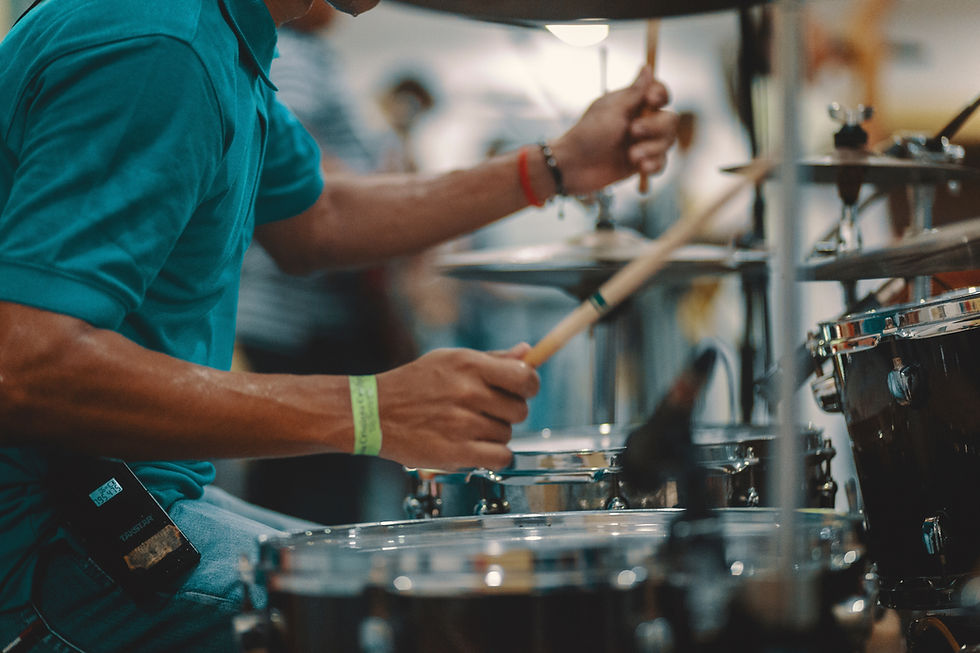
While in bed at the hospital one night, I was sleeping poorly and recalled being a drummer in a band much earlier in life; see Of Swords, Paradiddles and Solitaire (2020, on the Hub). So I began to perform bilateral drumming sequences - some of which were no long possible. I found that I could still move my left wrist in time with the right, although finger motions were a mess...
Let's look at that in more depth for a moment. (It helps if your roommate is as hard of hearing as I am, so you don't awaken them!)
When my hands were close to midline, wrist motions - and the digits controlled by the median nerve - were relatively intact. But I could not perform tasks that required quick motions of the 4th and 5th fingers of my left (L) hand. Drummers learn various sequences, called rudiments, one of which involves alternatively performing a beat that goes RLRR LRLL with the drum sticks. The rehabilitation unit did not have drum sticks, but moving my wrists in this rhythm was possible. Initially I could not perform the motions quickly, so I forced myself to slow down (grading) until I reached a speed where I could. Once this was possible, I gradually increased speed. When the wrist was more accurate I moved distally to the fingers - again, gradually increasing speed.
I doubt that you will often have a drummer as a client, but we are not trying to teach them drumming, are we? We are adopting the use of occupation as means; our goal is to return function of a limb, or the ability to perform a cognitive task.
During your acute treatments, teach your client how to analyse a task, how to break it down into sub-tasks and then to reassemble those sub-tasks into a whole. But you must do your homework. Before you can teach this, you must perform activity analysis of the desired task on your own.
Help them understand how their home treatment program will help them rebuild those skills.
This is tremendously important. If your client doesn't see the relationship between the home program you give them and recovering their independence, they will discard your plan. I worked for a home heath agency for a number of years and enjoyed it, but I was allowed a limited number of visits. If you educate your patient in a limited version of activity analysis, so that they can use objects and activities at home to promote self-treatment, they will be greatly increasing their overall treatment times.
However, treatment can easily go wrong if not organised well - as it did for my friend Joan. Joan was discharged home following surgery for appendiceal cancer. The surgeon ordered physiotherapy and occupational therapy, but the therapists did not contact her and came to see her too soon. Pain control had not yet been well established, so both therapists came at a time when her pain levels prevented her participation in therapy. Essentially, Joan never received therapy...

Returning back to my home treatment plan: Yesterday I added standing on the balls of my feet as I shaved, to improve balance. Then I wondered if I could shave with my left hand while doing this. Thankfully, I still have sufficiently functioning neurons to realise that, since I never did that pre-morbidly, it was not likely to end well!
Give clients permission to laugh, cry and/or swear...
As a client approaches discharge, consider bringing them and their significant other together in a private space. Ask them to talk about how the stroke has affected their lives and/or perception of themself. Long ago, I used to bring patients and spouses into my classroom. Although older, one couple were newly weds, of just six months. I said, "You may not have even considered that one of you could experience an event like this just six months after you started your lives together."
They were silent for a few minutes; my anxiety began to rise. Then they both began to cry. The patient's wife looked at me and said, "Nobody has ever invited us to talk about this."
For a time, they drew their attention away from us, speaking with each other about their love and their desire to work together.
Recovering the use of an arm or the ability to walk is vital, but just as important is the ability to talk about these experiences. Believe me, I am so thankful that during my experience of stroke, my own 'team' was there to speak to.
Closing thoughts

Take the time to learn what is important to a client, in terms of pre-morbid activities of daily living.
Take the time to understand the mechanisms which resulted in those deficits in those areas.
Teach and then challenge the client to perform their own activity analysis.
Think about having their spouse, significant other or family member photograph rooms and objects at home, prior to discharge.
Use those images to help the client select activities that will be part of that initial home program.
Encourage breaks… Maybe a walk around the unit or their house, when frustration overwhelms. I did this frequently while hospitalised and was amazed when a nurse stopped me and said, "You are the only patient who walks, others just lie in bed most of the day.”
Teach the client how to expand that home program out, beyond the initial one you give them. Therapy becomes life-long, but it can be tremendously rewarding as independence increases. Even failures along the way have the potential to bring on some serious laughter.
References and further learning
Cleveland Clinic (2023) Dysmetria (online). Available from: https://my.clevelandclinic.org/health/symptoms/25232-dysmetria. Accessed 21 April 2026.
Croninger, W. (2020) Of Swords, Paradiddles and Solitaire. In Therapy Articles, on The Occupational Therapy Hub (online). Available from: https://www.theothub.com/article/of-swords-paradiddles-and-solitaire. Accessed 21 April 2026.
Croninger, W. (2024) Are You Treating the 'Whole' Patient? In Therapy Articles, on The Occupational Therapy Hub (online). Available from: https://www.theothub.com/article/treating-the-whole-patient. Accessed 21 April 2026.
The Occupational Therapy Hub (2022) Occupational Therapy - Activity Analysis (PDF document). Available from: https://www.theothub.com/product-page/occupational-therapy-activity-analysis. Accessed 21 April 2026.


Nice article. We should not forget or get diverted from the basic tenets of the Occupational Therapy. Communication with the clients regarding process,effect, need of activities, dosage and meaningfulness must be explained during therapy sessions ands post discharge. Author rightly pointed out the value of appropriate home program for the client.