%20(dark%20background).png)
The Burn In Model: A New Model of Occupational Therapy
Updated: Aug 2
By Rhiannon Crispe and Dr. Michelle Luken
Co-Creators of The Burn In Model ©
Co-Founders of Embers™
Introducing The Burn In Model
The Burn In Model is a nature-based occupational therapy model that uses the metaphor of a flame to help people understand alignment, misalignment and sustainable well-being.

At its heart, it asks a simple question: Is your inner flame burning bright, or starting to fade?
Born from the realities of burnout, yet reaching far beyond it, The Burn In Model has been described as a model for our era. It offers a practical and reflective way to understand what sustains us, what drains us and how to live in greater alignment. Because of this, The Burn In Model can be applied across diverse practice areas - from clinical work with individuals across the lifespan, to supporting families, groups and communities, as well as in supervision, leadership, coaching and education.
Unlike many occupational therapy models developed primarily in academic settings, The Burn In Model was co-created by occupational therapists drawing on lived experience. It was shaped in community, through research, conversations and collective reflection - and refined through feedback from practitioners around the world.
Burnout vs. Burn In
The World Health Organization (WHO) defines burnout as a syndrome resulting from chronic workplace stress, that has not been successfully managed. While this definition captures an important aspect of burnout, it does not fully reflect how burnout is experienced real life.
Burnout extends far beyond the workplace. It shows up in caregiving, parenting, activism, navigating systemic injustice and the unique pressures of neurodivergent living. It can emerge in any life role, whenever there is a deep and sustained misalignment between a person's being, doing and sense of belonging.
In The Burn In Model, burnout is understood as a state of complex and ongoing misalignment between who we are (Being), what we do (Doing) and who or what we are connected to (Belonging). When these elements remain out of sync over time, the Inner Flame dims and may eventually burn out.
Burn In is the opposite. It is a state of strong and sustained alignment between Being, Doing and Belonging.
Our Inner Flame burns bright, steady and strong when we are...
showing up as our authentic self
engaging in meaningful occupations
connecting with people and places that foster belonging
This experience is not limited to adults, or to any one group of people. Children, young people and older adults can all Burn In. Across every life stage and role, alignment supports vitality, connection and a sense of aliveness.
Both burnout and Burn In can look and feel different from person to person.

The Burn In Model recognises the dynamic and ever-evolving nature of life and alignment. No one Burns In every moment of every day. There will be days, weeks or seasons when alignment feels hard to reach - and that is part of being human. Regardless of the state of one's flame, The Burn In Model offers an invitation to notice it and tend to it.
The Flame and Its Ecosystem
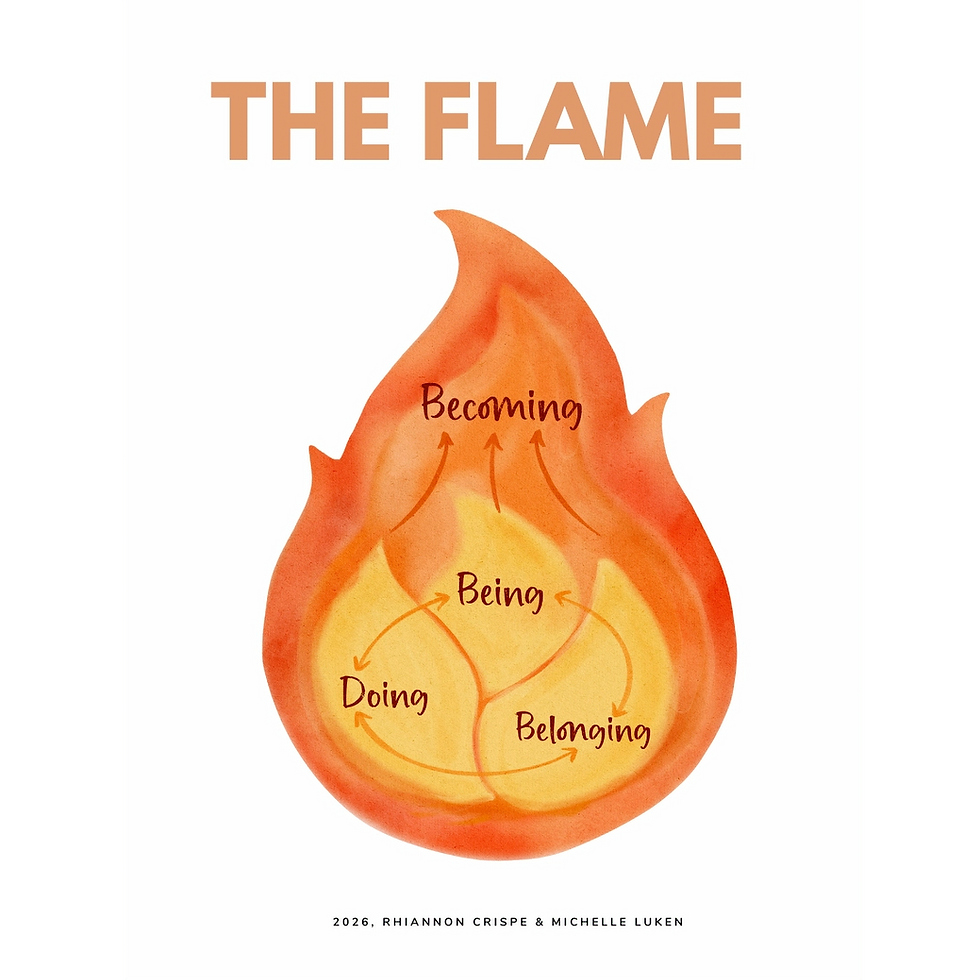
At the centre of The Burn In Model is the flame. The flame has two parts:
Inner Flame
Reflecting the alignment between Being, Doing and Belonging. The greater the alignment, the stronger and steadier the flame. When these elements drift out of sync, the flame may dim or shrink.
Outer Flame
Representing growth and transformation, or Becoming. As alignment strengthens, the potential for authentic growth expands.
No flame burns alone.
It is always shaped by an ecosystem, made up of core elements, fuel and conditions that sustain or challenge it - and the ripple effects it creates.
Together, the elements shape how our flame burns and how it impacts the world around us.

What Makes The Burn In Model Unique
The Burn In Model stands on the shoulders of occupational therapy models and frameworks that came before it - including the Doing-Being-Becoming-Belonging framework, the Person-Environment-Occupation Model, the Kawa Model and the Occupational Therapy Practice Framework. These models have shaped how we understand occupation, identity and context. The Burn In Model honours this lineage, while extending it in new and necessary directions.
It brings into view aspects that have often remained unnamed in occupational therapy theory, such as:
boundaries
burnout signals
gifts to the world
lineage
legacy
These dimensions profoundly shape whether a person's Inner Flame flourishes or fades, yet they are rarely made explicit within existing models. When these experiences remain unnamed, they are easily overlooked by systems, practitioners and clients alike. By naming them, The Burn In Model gives language and legitimacy to what occupational therapists have long recognised in practice.
While grounded in occupational therapy and occupational science, the relevance of The Burn In Model extends beyond the profession. It can be used by therapists, psychologists, coaches, teachers, leaders, parents and community groups - as a shared language to guide reflection, conversation and action, wherever people are seeking greater alignment and well-being.
From Theory to Practice
The Burn In Model is designed to be used in the real world. Its concepts are intuitive, metaphor-driven and adaptable, making them accessible for reflection, assessment and intervention.
The Burn In Model is supported by a practical framework, that guides practitioners and clients from insight to action. This process supports people to map their flame, notice alignment and misalignment, identify supports and challenges and create pathways toward Burn In.
Simple tools help open conversations and track change. A practitioner might invite a client to sketch their flame and surrounding ecosystem elements, to visualise their current state - then revisit the drawing later as a pre- and post-assessment comparison. A brief check-in such as, "On a scale of one to five, how is your flame burning today?" can serve as both a reflective prompt and a way to monitor progress.
In this way, The Burn In Model becomes more than theory. It becomes a shared language, that helps people name what they feel, see what has often gone unseen and move toward alignment together.
A Bold Vision

The Burn In Model was never intended to be confined to academic literature or training manuals. Its vision is intentionally expansive.
We see The Burn In Model being used across professions and settings...
By therapists, teachers, leaders and caregivers. By schools checking in with children about their flame. By workplaces seeking to sustain their people, rather than drain them. By communities, ready to move beyond survival and into collective well-being.
We envision books, workshops and conversations carrying The Burn In Model into homes, workplaces and communities worldwide.
So when people talk about their lives, their work and their well-being, they don't only name what's draining them; they have language for what keeps their flame alive.
Next Steps
You are invited to explore The Burn In Model in your own life and practice, in ways that feel right for you.
You might start by using it for personal reflection, journaling or everyday conversations, then bring it into your work with clients, families or teams.
If you would like further guidance, resources and shared language, you can explore our eBook, or connect with us here for ongoing learning and community.


I would love to translate this in Greek, English occupational therapy terminology is difficult for Greeks to understand as well! What an exciting era for OT! I love that it incorporates so many characteristics from other models! And the storytelling..the visuals..are just perfect!
I love this model!!! I am a visual learner so I love all things metaphor and imagery as this is often how I make sense of my experiences and that of others. I love how this model really provides space to talk and normalize burnout as a systemic issue rather than personal failure as many of us feel when we experience this increasingly common condition. Though burnout is temporary, it has lasting impacts on individuals mental, physical, and general health and well-being. I love the push for action too as it gives those struggling hope into how to find their spark again. Thank you so much for your work and I would love to read more about the other environmental…
Hello, this model is really interesting ! The fire allegory is really inspiring.
I'm a french OT and I would like to collaborate with you in order to translate it in french so the french community of occupational therapists could use it more easily :) (we tend to struggle with english sources).